
Monkeys, Grapes, and Cucumbers
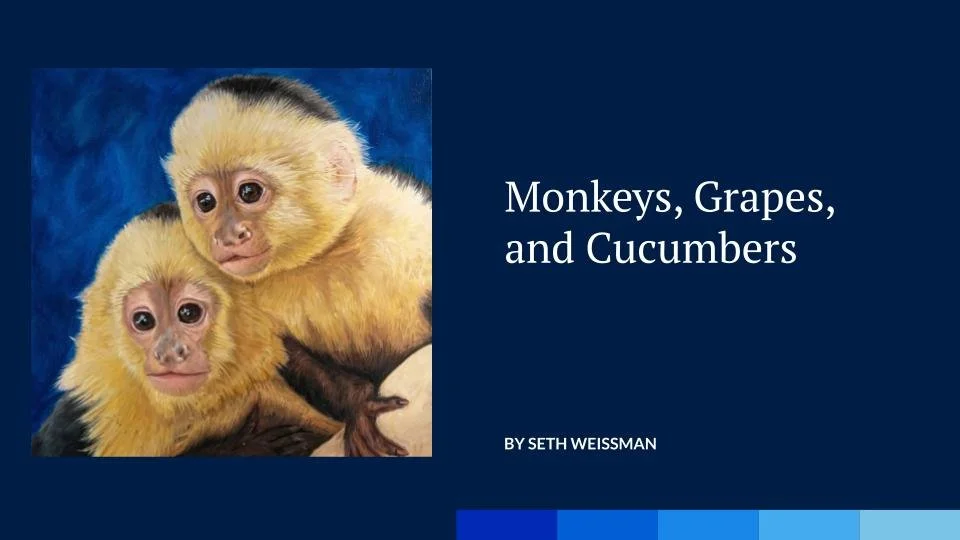
“Where are my grapes!”
In this article, I explore a famous experiment regarding fairness in primates and what it reveals about how humans process pay, equity, and contentment. We are, after all, primates.
The Capuchin Monkey Experiment
Cucumbers are Good: In a 2003 study in the journal “Nature”, capuchin monkeys exhibited strong reactions to what they perceived as unequal rewards for performing the same task.¹ The experiment involved pairs of monkeys housed side by side, each trained to exchange a small rock for food. Initially, both monkeys received cucumber slices as a reward, which they accepted without issue—monkeys like cucumbers, and everyone was happy to be fed.
Grapes are Better: However, the dynamic changed when one monkey started receiving grapes instead of cucumbers for performing the same task. Capuchin monkeys like cucumbers, but they love grapes, and this is when it got interesting. Upon witnessing its “coworker” receive the coveted grapes while it continued to receive just cucumbers, the monkey receiving cucumbers became angry. So angry that it refused to eat the cucumber and promptly threw it back at the human!
This experiment was repeated with several variations, including monkeys being rewarded with food tokens rather than receiving food directly. The results consistently showed that monkeys who received fewer rewards than their peers exhibited behaviors indicative of frustration and discontent. Go figure.
How does this translate to people? It's even more interesting, if a bit more complicated.
Drawing Parallels to Human Behavior and Pay Disparity
The findings of the monkeys/grapes/cucumber experiment offer valuable insights into human psychology, particularly where perceived fairness in pay becomes a significant concern. Humans, like capuchin monkeys, possess an innate sense of justice and fairness. When individuals perceive that their efforts are not adequately rewarded compared to peers, they experience negative emotions such as resentment, frustration, and diminished motivation. This disparity in rewards, akin to receiving cucumbers while others receive grapes, can lead to feelings of inequity and demotivation.
In one experiment² published in the magazine Science, pairs of participants performed identical tasks in a functional MRI (fMRI) scanner and were informed of their own earnings and those of their partner. Their satisfaction was driven not by absolute income, but by relative income. The same thing we all experience when scrolling through social media: everyone else seems to be living the rock-star life we are not.
In a similar experiment published in Science in 2009³, participants simply read stories about people earning more or less than themselves. And, not surprisingly, the pain regions of their brains were activated when participants read the stories about others making more than they did.
The conclusion is that the human brain does not value money in absolute terms; rather, it values it in comparison to others. If you come home with a $5,000 spot bonus and find out that your peer got a $6,000 bonus, you are unhappy, even though you are $5,000 richer. Even if you only read about a stranger making more money than you, it stings! Just like the capuchin monkey, you were content until you compared yourself to someone else.
Much of this is rooted in real-world experience. Unequal pay based on immutable characteristics is still prevalent. High-profile cases of executives receiving disproportionately large bonuses or salaries compared to lower-level employees, despite economic downturns or company underperformance, often attract public scrutiny and internal unrest.
Relative Deprivation
And not all of it is rooted in real-world events. Some of it takes root in our minds in a phenomenon called “relative deprivation.” Relative deprivation is the feeling of dissatisfaction that arises when you compare yourself to others and perceive yourself as worse off, even when your own situation has improved. And anyone, even someone extremely wealthy, can experience it.
Our minds are meaning-making machines, and whenever we experience relative deprivation, we seek a reason to explain it. Neuroscience reveals that when we perceive unfairness or inequality, our brains activate at least three different regions, leading to feelings of disgust, pain, conflict, vigilance, and confusion.
That last part is key. The brain doesn’t do well with “unexplained inequity.” It seeks a story to make sense of it. If it can’t find a neutral or situational reason (“they brought in more business,” “they billed more hours”), it often fills the gap with an intentional explanation (“someone did this to me,” “this system is biased,” “they don't value me”). Psychologists call this need to explain Attribution Theory.⁴ We don’t like not knowing why things happened, so we make up causes to make sense of them. In fairness situations, that often means assuming someone made an unfair choice. “There must be a reason they got more grapes than I did,” the mind concludes—and when no reason is visible, it usually decides the reason must be unfairness.
Knowing all of these mind traps, how do we lead ourselves and our teams?
Leading Ourselves: Cultivating a Mindset of Contentment and Gratitude
In addressing our own perceptions of compensation inequality, fostering a mindset of contentment and gratitude can play a pivotal role. Rather than fixating on comparing ourselves to others, we can benefit from appreciating our current circumstances and accomplishments. Research in positive psychology has highlighted the benefits of practicing gratitude, including improved mental well-being, enhanced resilience to stress, and greater life satisfaction.⁵ Gratitude activates the brain’s prefrontal cortex and reward circuits, counteracting the ‘unfairness’ response. Wanting what you have is far more potent than having what you want.
Leading Others: Fairness Conversations
So what do we do with all of this as leaders? As a leader, your first task is to ensure that when employees are aware of different pay, you dispel the perception that it is also unfair pay. Our first priority is to demonstrate a compensation process that is transparent, consistent, and grounded in principles, rather than favoritism. Your second priority? Lead with empathy. Understanding that employees feel relative deprivation (you do too) helps you say things like:
“I know compensation matters — it should. I also want to ensure that you feel your work is meaningful, that you’re growing, and that you have the autonomy to do great things. Those are the drivers of lasting satisfaction. I’m committed to your growth and development, and you are a valuable member of this team.”
"For you to continue to grow and have a larger impact on the team and/or within the company, I think you'd get the greatest leverage by focusing on x and y."
This is the conversation where you talk about what they're great at, where there's room for growth, and how you'll support them on that journey. And it does not mean they are not valued currently. Assuming the comp conversation comes after a performance conversation, you will have already discussed strengths/opportunities, and then you can refer to them at this point. It should be made clear that their continued growth and development, and impact on the company, is the path to higher compensation.
This reframes the issue from only about compensation to working somewhere where you are valued, invested in, and seen, and one where your growth and impact are rewarded.
Conclusion: Wanting What We Have
Money matters. And it's not the only thing that makes a job fulfilling or a career resonant. The desire for fairness in compensation, as demonstrated by both capuchin monkeys and humans, underscores the universal quest for equity and justice. However, navigating perceptions of inequality requires a nuanced approach that reframes gratitude for what one has rather than dwelling on perceived disparities. Ultimately, wanting what we have for ourselves rather than fixating on what we lack compared to others fosters a healthier, more fulfilling work environment and life. Grandma always said that “comparison is the thief of joy.” As leaders, our role is to differentiate pay based on performance, while maintaining empathy for how those disparities are experienced within our teams. And once I learned all of this, I never looked at a bunch of grapes the same way.
For more thoughts, visit me on LinkedIn
¹ Brosnan, S., de Waal, F. Monkeys Reject Unequal Pay. Nature (2003).
² The Neural Basis of Social Comparison (Fliessbach et al., Science, 2007).
³ Neural Correlates of Envy and Schadenfreude (Takahashi et al., Science, 2009).
⁴ Fritz Heider, The Psychology of Interpersonal Relations (New York: Wiley, 1958); Bernard Weiner, “An Attributional Theory of Achievement Motivation and Emotion,” Psychological Review 92, no. 4 (1985).
⁵ The effects of gratitude interventions: a systemic review and meta-analysis.
